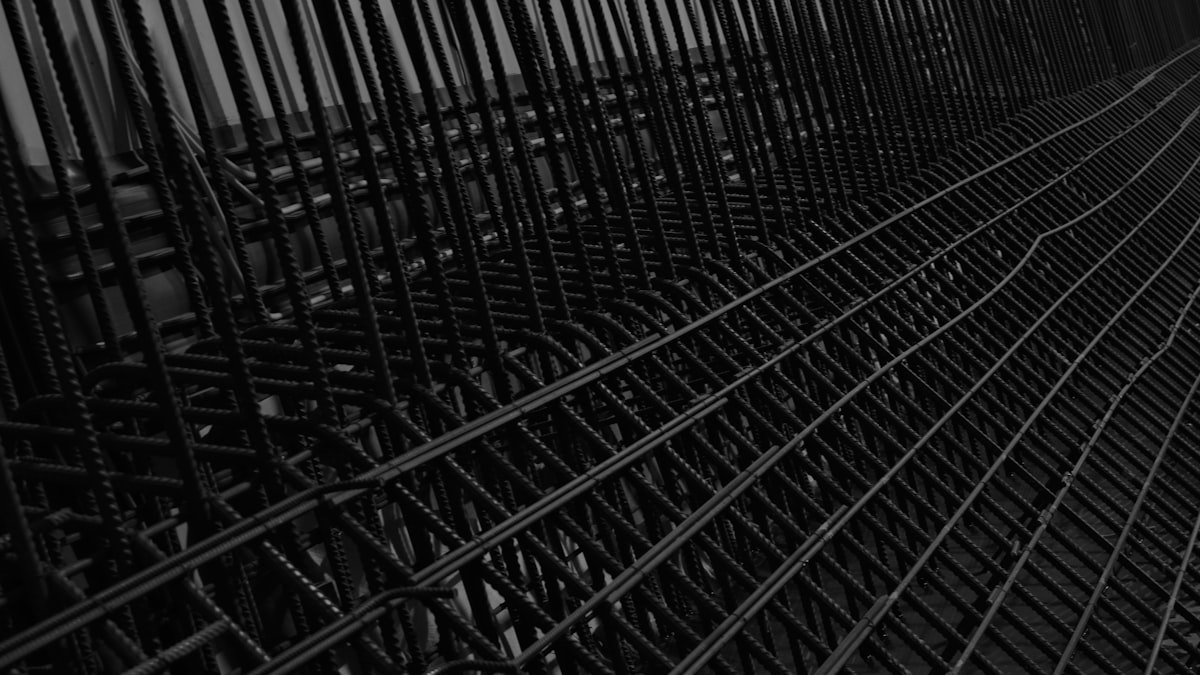
When we think of phosphating, powder coating shops usually come to mind first. But one of the most impactful applications of phosphate coatings is in infrastructure — specifically, protecting the TMT (Thermo-Mechanically Treated) reinforcement bars that form the skeleton of our bridges, dams, buildings, and highways. Corrosion of rebar is the single largest cause of structural deterioration in reinforced concrete, and phosphating offers a practical, cost-effective solution.
Why TMT Bars Corrode Inside Concrete
You might assume that steel embedded in concrete is safe from corrosion. After all, the concrete completely encases the rebar. But concrete is not the impenetrable barrier it appears to be.
The Alkaline Protection — and Its Limits
Fresh concrete is highly alkaline, with a pH of 12 to 13. At this pH, a thin passive oxide layer forms naturally on the steel surface, protecting it from corrosion. This is why reinforced concrete structures can last decades without visible rebar corrosion.
However, this alkaline protection is not permanent. Two primary mechanisms destroy it:
Chloride Ingress
Chloride ions — from marine environments, de-icing salts, or even chloride-contaminated aggregates — gradually penetrate into the concrete through its pore structure. When the chloride concentration at the rebar surface reaches a threshold level (typically 0.2 to 0.4 percent by weight of cement), it breaks down the passive oxide layer and initiates pitting corrosion. This process can take years or decades, but once it starts, it accelerates rapidly.
In coastal areas of India, marine salt spray can carry chlorides deep into concrete structures. Bridges, jetties, sea walls, and buildings within a few kilometres of the coast are all vulnerable.
Carbonation
Carbon dioxide from the atmosphere slowly diffuses into concrete and reacts with the calcium hydroxide in the cement paste, converting it to calcium carbonate. This reaction reduces the pH from 12 to 13 down to about 8 to 9 — a level at which the passive oxide layer on the rebar is no longer stable. The carbonation front advances inward from the concrete surface at a rate that depends on the concrete quality, humidity, and CO2 concentration, typically reaching the rebar depth within 15 to 30 years in moderate environments.
Once the carbonation front reaches the rebar, or once chlorides have penetrated to the steel, corrosion begins. And rebar corrosion is uniquely destructive.
The Corrosion Cascade
When rebar corrodes, the iron oxide (rust) produced occupies 2 to 6 times the volume of the original steel. This volumetric expansion generates enormous internal pressures within the concrete — pressures that the concrete's relatively low tensile strength cannot withstand. The result is cracking, spalling (chunks of concrete breaking away), and eventually delamination of the concrete cover.
These cracks, in turn, allow faster ingress of moisture, oxygen, and chlorides to the rebar, accelerating the corrosion further. This self-reinforcing cycle of corrosion, cracking, and accelerated corrosion is why reinforced concrete deterioration, once it begins, progresses at an increasing rate.
The structural consequences are serious. Loss of rebar cross-section reduces the load-carrying capacity of the member. Loss of bond between rebar and concrete (due to cracking and delamination) reduces the structural member's ability to resist bending and shear forces. In extreme cases, this leads to structural failure.
How Phosphating Protects TMT Bars
A phosphate conversion coating on TMT bars provides protection through several mechanisms:
Barrier Protection
The phosphate crystal layer forms a physical barrier between the steel surface and the aggressive agents (chlorides, moisture, carbonated concrete) in the surrounding environment. While no barrier is perfectly impermeable, the phosphate layer significantly slows the rate at which corrosive species reach the reactive steel surface.
Improved Passivity
The phosphate coating helps maintain the passive condition of the steel surface for longer periods. Even as the concrete carbonates or chlorides penetrate to the rebar level, the phosphate layer provides an additional margin of protection before active corrosion can initiate.
Compatibility with Concrete
Unlike some protective coatings (such as epoxy or certain polymer coatings), phosphate conversion coatings do not significantly reduce the bond strength between the rebar and the surrounding concrete. The rough, crystalline surface of the phosphate coating actually provides good mechanical interlocking with the cement paste. This is a critical advantage, because rebar-concrete bond is essential for the structural behaviour of reinforced concrete.
InstaPhos BTP: Designed for Cast Iron and TMT
For infrastructure applications, MHRV Enterprises offers InstaPhos BTP — a phosphating product specifically formulated for cast iron and TMT bars. The formulation is optimised for the unique characteristics of TMT bar surfaces, which differ from typical mild steel sheet in their surface roughness, residual scale, and metallurgy.
InstaPhos BTP can be applied by brushing or spraying, making it practical for treating individual bars or bundles of bars on-site. There is no need for dip tanks or heated baths, which is particularly important for infrastructure projects where treatment must happen at the construction site or in a rebar fabrication yard.
Application Methods for Long Bars
TMT bars present a practical challenge: they are long, heavy, and produced in large quantities. Traditional dip-tank phosphating is often impractical for full-length bars (typically 12 metres). Here are the methods used:
Spray Application
For high-volume treatment, the solution can be sprayed onto bars as they pass through a treatment station. Bars are laid on rollers, and nozzles apply the phosphating solution from multiple angles to ensure complete coverage. This method is efficient for rebar fabrication yards processing large quantities.
Brush Application
For smaller quantities or site-based treatment, brush application works well. A team of workers can treat bundles of bars by brushing the solution onto exposed surfaces. This method is commonly used on construction sites for critical structural elements.
Partial Dipping
For shorter cut lengths (stirrups, links, chair bars), dipping in a non-metallic trough is practical and efficient. The trough only needs to be slightly longer than the longest piece being treated.
Cost-Effectiveness vs Epoxy Coating
Epoxy-coated rebar (ECR) has been promoted as a solution to rebar corrosion, particularly in bridge decks and marine structures. However, epoxy coating has significant limitations:
- Cost: Epoxy coating adds substantially to the cost per tonne of rebar. The coating process requires specialized equipment (cleaning, heating, spraying, and curing lines) and quality control.
- Damage sensitivity: Epoxy coatings are vulnerable to mechanical damage during handling, transportation, tying, and concrete placement. Even small holidays (bare spots) in the coating can become sites for concentrated corrosion.
- Bond reduction: Epoxy coating reduces the bond between rebar and concrete, which must be compensated for in structural design through longer development lengths and lap splices.
- Debonding over time: Studies have shown that epoxy coatings can lose adhesion to the steel over time, particularly in moist environments, undermining their protective function.
Phosphating avoids these issues. The coating is thin, tough, and chemically bonded to the steel. It does not reduce concrete bond. It is not damaged by normal handling. And the cost per tonne of treated rebar is a fraction of the cost of epoxy coating.
A Practical Investment in Infrastructure Longevity
India is investing massively in infrastructure — highways, metros, bridges, dams, and urban development. The durability of these structures depends fundamentally on the durability of the embedded reinforcement. Corrosion of rebar is already the leading cause of premature deterioration of concrete structures in India, with repair costs running into thousands of crores annually.
Phosphating TMT bars before they are embedded in concrete is one of the most cost-effective measures available to extend the service life of reinforced concrete structures. The cost is minimal — a few rupees per kilogram of rebar. The potential savings in avoided repair and rehabilitation costs are enormous.
For construction companies, rebar fabricators, and infrastructure developers, phosphating reinforcement is not just good practice — it is a smart investment in the long-term value of the structures they build.